

🎉Thank you all for your support, and thank you for your patience. We know many of you have been waiting for this.
A yearly subscription to the Substack column is USD 159.99 and includes about 110 to 120 case studies published over the course of the year. In addition, all annual subscribers will receive complimentary access at the end of the year on ichingstream.com to the annual collected casebook, which includes about 150 case studies in total and is otherwise sold separately for USD 179.99.
Thank you again for reading, subscribing, and supporting this work.❤️
Column intro
I Ching Stream is the first institution to systematically translate the core classical texts of Chinese I Ching divination into English while preserving the authentic technical framework of Six Lines Divination, or Wen Wang Gua, the comprehensive applied form of this tradition, integrating interpretation of the hexagram and line statements within the Great Expansion tradition, image-based interpretation, and the Na Jia method.
I Ching Divination Advanced is a practical English-language series on Six Lines Divination (Liu Yao) and Wen Wang Gua for readers who want to develop professional-level analysis. Each post takes one advanced concept and turns it into a method you can apply in real readings, with precise terminology, short explanations, focused examples, and case studies. The emphasis is on repeatable judgment grounded in classical frameworks, so your interpretations become consistent, verifiable, and technically sound.
For Basics, please see:
For Advanced, please see:
If you would like more formal notes and reference-style materials, you can also browse my Academia page.
For study resources, the English-language Chinese Perpetual/Lunar Calendar, and professional casting tools, visit ichingstream.com.
Disclaimer:
All personal information in this case study has been anonymized or omitted. This case study is provided for learning and reference only. It is not intended as medical, veterinary, legal, financial, investment, or other professional advice.
Time of divination: March 13, 2026, at 8:43 PM.
Stem and branch time: III G year, VIII D month, III L day (void: G and H), V L hour.
A female querent asked about reconciliation. The background was that she suspected her ex-boyfriend had a third party, although he did not admit it. At the moment of casting the hexagram, she was full of doubt about this matter, and at the same time asked whether the two of them could reconcile. She obtained Qian to Tong Ren.
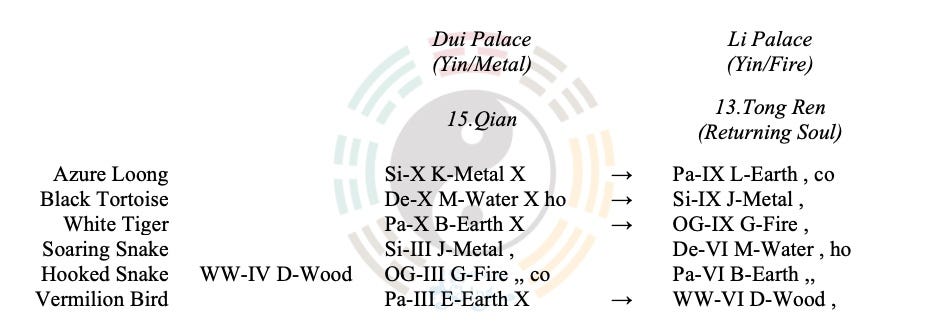
Judgment: In this hexagram, the first line, the fourth line, the fifth line, which was the host line, and the top line were all active. This was a hexagram with an unusually large number of active lines.
Many active lines indicate upheaval in the matter: Because there were too many changes in the hexagram, the matter was judged to be highly turbulent. When many lines are active at once, it is often difficult to grasp a single clear main thread, which itself shows that the emotional entanglement was extremely complicated and full of twists and reversals. In “I Ching Divination: Complete and Restored” (Zengshan Buyi, 《增删卜易》), this falls under the discussion of “chaotic movement of the six lines,” where too many active lines point to unstable developments, tangled clues, and a situation that cannot be judged correctly from surface appearances alone. Cases of this kind are precisely where many readers misjudge the hexagram if they focus only on one line or one seemingly favorable sign. For a fuller treatment of how to read these structures, including “chaotic movement of the six lines” and “solitary activity,” see my translation of Zengshan Buyi.
The man did in fact have other romantic entanglement: As was pointed out from the perspective of hexagram interpretation, the significator god, namely the corresponding line officials and ghosts, concealed the wife and wealth D line, which also coincided with the D monthly command. In relationship divination, officials and ghosts represent the man, while wife and wealth represent a woman. This clearly showed that there was indeed another romantic opportunity, ambiguous involvement, or female entanglement around the man.
Why the matter was so difficult to judge cleanly: On the one hand, the hexagram was full of movement, which already showed instability and repeated reversals. On the other hand, the querent was asking about reconciliation while at the same time carrying strong suspicion about another woman. This meant that the emotional question itself was not pure and simple, but had already become mixed together with distrust, concealment, and outside interference. Therefore, even if reconciliation were to occur, it would not easily be a clean or stable reconciliation.
The transformed hexagram being Tong Ren, a returning soul hexagram, also suggested that the two might ultimately come back together. In relationship matters, a returning soul hexagram often points to something returning to its former place. However, in this case, because the hexagram also showed chaotic movement and hidden romantic entanglement, this return did not indicate a stable resolution, but only that reconciliation remained possible.
Conclusion: This hexagram showed that reconciliation was possible, but not in a clean or stable way. The transformed hexagram was Tong Ren, a returning soul hexagram, which suggested that the two might still come back together in the end. However, the original hexagram was marked by chaotic movement, and it also showed hidden romantic entanglement on the man’s side. Because of this, even if reconciliation were achieved, it would be difficult, unstable, and unlikely to resolve the underlying emotional knot. In other words, this was not the image of a naturally restored relationship, but rather that of a forced reunion with the root problem still left unresolved.
Feedback: It was later confirmed that the ex-boyfriend had in fact moved on without any real gap, and after the breakup immediately entered ambiguity with another woman whom he had already known before, which matched the information shown in the hexagram. Although the hexagram was complicated and the man already had an ambiguous object, the querent was extremely persistent, and through very intense means eventually forced a reconciliation sometime in the latter part of March. However, the knot in her heart was never resolved. Even after getting back together, she still could not truly accept the fact that he had been ambiguous with someone else, and afterward continued casting many more hexagrams about the matter.
Bonus Case from “I Ching Divination: Complete and Restored” (Zengshan Buyi, 《增删卜易》)
A related discussion appears in “I Ching Divination: Complete and Restored” (Zengshan Buyi, 《增删卜易》), where Old Man Yehe discusses the problem of chaotic movement and solitary stillness.
“In the month of C, on the VII L day (void: C and D), a divination was made regarding a daughter’s illness. The hexagram obtained was “Wei Ji to Jian”. [132]
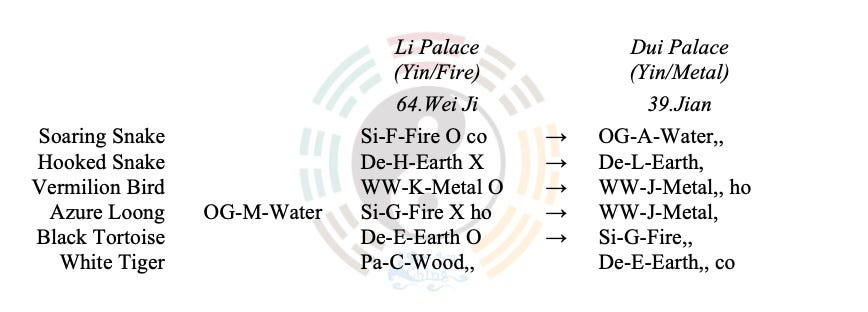
In ancient times, some would determine the time of fulfillment based on a solitary static line. For example, in this hexagram, the C Wood is the solitary static line. Without considering the significator line, should one predict the event to occur on a C day, or predict it to end on a C day? In this hexagram, Earth represents descendants. Though in a rest and constraint state, it is generated by active F Fire and G Fire. The H Earth descendants line transforms into an advancing god, and the E Earth descendants line transforms into a returning generation. Thus, it is predicted to recover on a C day. However, even so, I dared not make a definitive judgment.”
This example is valuable because it shows that once the hexagram enters a state of chaotic movement, even experienced practitioners become especially cautious. The issue is no longer simply whether one line looks favorable or unfavorable on the surface, but whether the overall structure allows a stable judgment to be made. That is exactly why cases of this kind require more than mechanical line reading. They require careful attention to the significator, the host line, the chain of generation and overcoming, and the balance between movement and stillness. Readers who want to study this type of structure more systematically can find a fuller discussion in my translation of Zengshan Buyi.
If there are certain themes you would like to see in future case studies, welcome to leave a comment and share what kinds of divination cases interest you most.
Further reading: English Editions of I Ching Divination Classics
“I Ching Divination: A Practical Study Roadmap: A Simplified Guide to the Na Jia Method (Wen Wang Gua), Based on I Ching Divination: Complete and Restored (Zengshan Buyi 增删卜易)”
A practice-first roadmap for setting up charts, learning the core workflow, and building timing-aware judgment with a simplified, beginner-friendly structure.
→ Amazon US“I Ching Divination: Complete and Restored (Zengshan Buyi 增删卜易), Part 1 (Vols. 1 to 2)”
Foundations for Six Lines (Liu Yao), Wen Wang Gua, and the Na Jia Method. 460+ case studies (Part 1 & 2)
→ Amazon US“I Ching Divination: Complete and Restored (Zengshan Buyi 增删卜易), Part 2 (Vols. 3 to 4)”
Advanced rules with worked cases, practical checklists for real readings. 460+ case studies (Part 1 & 2)
→ Amazon US“The Orthodox Method of I Ching Divination (Bushi Zhengzong 卜筮正宗), Book 1 of 2 (Vols. 1 to 4)”
Classic framework and methods, including the Golden Strategy and core disputes.
→ Amazon US“The Orthodox Method of I Ching Divination (Bushi Zhengzong 卜筮正宗), Book 2 of 2 (Vols. 5 to 7)”
Eighteen key questions with case-based explanations for confident judgment.
→ Amazon US“Studies on Ancient I Ching Divination Cases (Zhouyi Gushi Kao, 《周易古筮考》) English Edition, Book 1 of 2”
Yarrow-stalk casting, core principles, and a structured way to read classical divination cases with confidence.
→ Amazon US“Studies on Ancient I Ching Divination Cases (Zhouyi Gushi Kao, 《周易古筮考》) English Edition, Book 2 of 2”
Deeper case work and advanced interpretive frameworks, designed to sharpen judgment through extended historical examples.
→ Amazon US“Fire Pearl Forest (Huo Zhu Lin 火珠林): A Classical Text on Six Lines Divination”
Technical essentials favored by practitioners, clear structure for application.
→ Amazon US“Undersea Eye (Haidi Yan 海底眼): The Core Principles of Six Lines Divination”
Core principles that train pattern recognition and timing in real casts.
→ Amazon US“Collected Insights on I Ching Divination (Yi Donglin 易洞林)”
Includes Donglin Secret Manual (洞林秘诀), Guo Shi Donglin (郭氏洞林), and Zhouyi Donglin (周易洞林).
→ Amazon US“Hidden Principles Ode: A Classic of I Ching (Six Lines) Divination (Chan Ao Ge Zhang 阐奥歌章)”
A concise classic that clarifies core judgments and shows how to turn short verses into usable guidance.
→ Amazon US“Principles and Odes of I Ching Divination”
Includes Mysterious and Subtle Discourse (Tong Xuan Miao Lun 通玄妙论) and Celestial Mysteries Ode (Tian Xuan Fu 天玄赋), organized for quick reference in real readings.
→ Amazon US